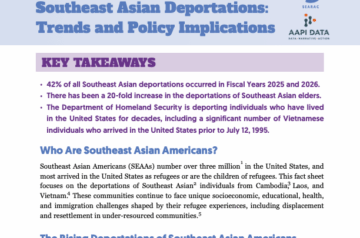
Washington, DC and Berkeley, CA—The Southeast Asia Resource Action Center (SEARAC) and AAPI Data today released Southeast Asian American Deportations: Trends and Policy Implications, a new fact sheet revealing a sharp rise in deportations of Southeast Asian Americans (SEAA). The fact sheet also highlights the growing impact of immigration enforcement on SEAA communities and the loss of long-standing protections for Vietnamese refugees who arrived in the United States before July 12, 1995.
The analysis finds that 42% of all Southeast Asian deportations since 1998 occurred in Fiscal Years 2025 and 2026 alone. The increase is particularly significant among Laotian and Vietnamese communities, with 64% of all Laotian deportations and 51% of all Vietnamese deportations occurring during those two fiscal years.
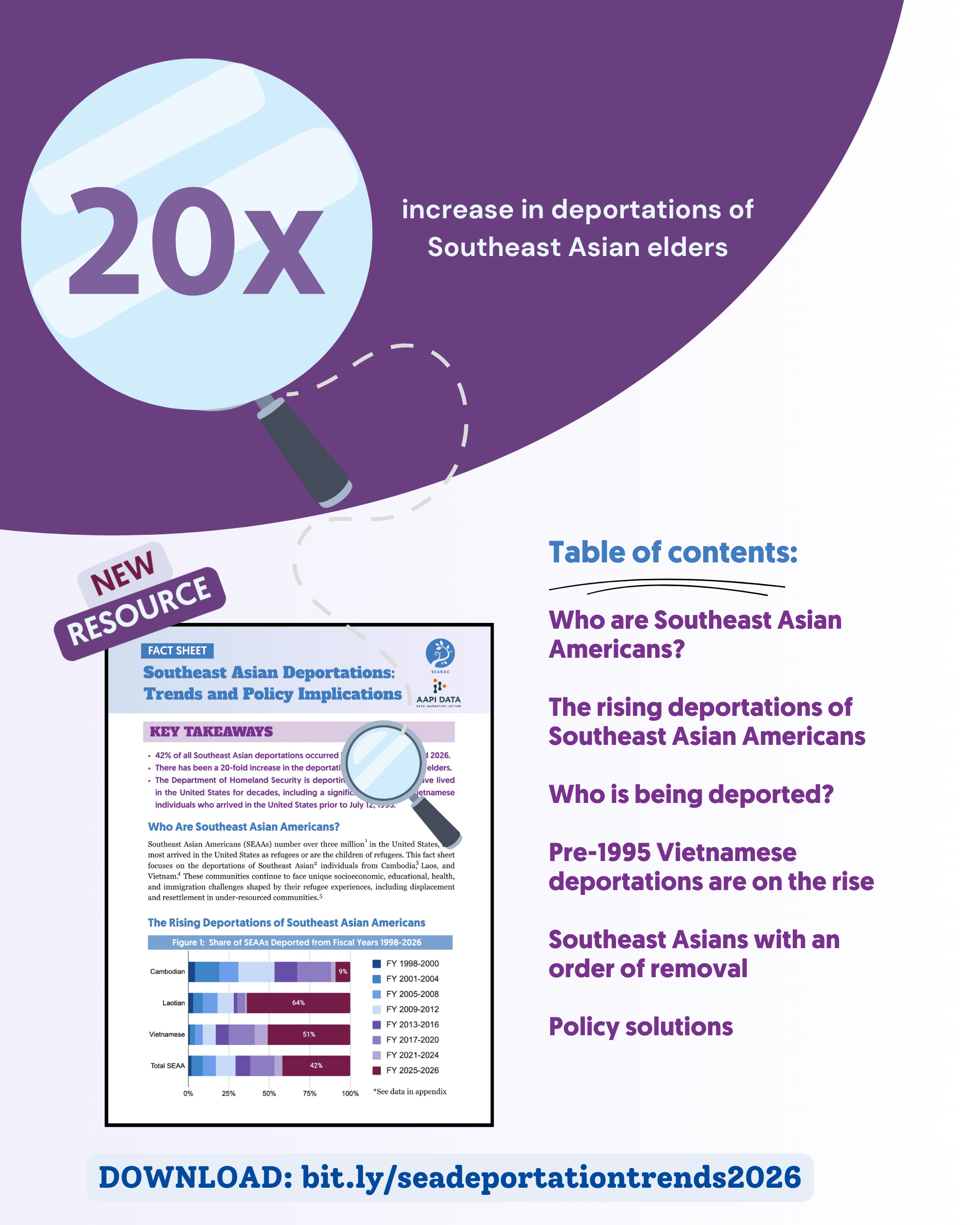
The fact sheet also highlights the growing deportation of Southeast Asian elders. In FY 2024, nine Southeast Asian elders were deported; in FY 2025, that number rose to 182, representing a more than 20-fold increase in a single year. Many deported individuals have deep roots in the United States: 78.6% of Southeast Asians deported in FY 2025 and FY 2026 had convictions at least a decade old, while more than half had convictions dating back two decades or more.
These findings reinforce the urgent need for policy change. The fact sheet concludes with policy recommendations to limit deportations of Southeast Asian refugees, reform the immigration enforcement system, and strengthen oversight.
“Our analysis shows the devastating consequences of an immigration enforcement system that is separating families and deporting people who have spent decades building their lives in the United States,” said Quyên Đinh, Executive Director of SEARAC. “With thousands of Southeast Asian Americans still living under final orders of removal, we must act now to protect our communities and keep families together.”
“Given SEARAC’s expertise on the Southeast Asian American community and their extensive community partnerships, we were excited to collaborate with them on this important fact sheet,” said Karthick Ramakrishnan, Founder and Executive Director of AAPI Data. “I’m also thankful for the work of Michele Wong, our postdoctoral researcher who was instrumental in partnering on this research. It’s vital that we produce accurate and timely data on the impact of immigration enforcement for policy advocacy and community engagement to be effective.”
More than 19,000 Southeast Asians have received orders of removal since 1998, with approximately 14,700 still living in the United States under a final order of removal.