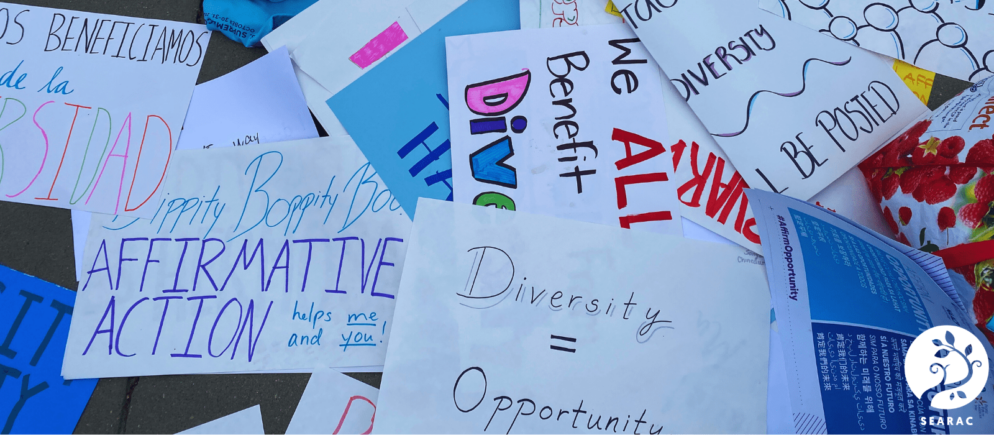
Washington, DC – SEARAC denounces the Supreme Court’s decision to roll-back the use of affirmative action in higher education. Southeast Asian American (SEAA) students, as do many other Asian American students, benefit from race-conscious affirmative action. These policies allow our students’ full potential to be seen including their experiences, backgrounds, and race.
SEAA students are uniquely impacted by systemic racial inequity leaving them overlooked and misunderstood. They are descendants of the largest refugee community ever resettled in America as survivors of war, genocide, and trauma that impact their educational outcomes. When racial data is disaggregated, it shows that SEAA students graduate at lower rates than other students. For instance, the 2010 Census shows that more than 60% of Cambodian, Lao, and Hmong Americans do not have a bachelor’s degree, as do more than 50% of Vietnamese Americans. Affirmative action policies allow schools to take these students’ experiences into consideration and close the college gap in our communities. SEARAC’s executive director and board respond to the decision below:
“My family’s experience as refugees has shaped our lives. My parents risked their lives to be free including the freedom to learn. For Southeast Asian communities, that freedom to learn comes from inclusive and equitable education policies that take into consideration the trauma and scars we carry across generations,” said Quyên Đinh, executive director of SEARAC. “We condemn this decision that ignores the barriers to education we face. We will continue to fight for policies that help Southeast Asian students, including the right to be seen through disaggregated data and ethnic studies. With communities across the country, we will fight for a future where every individual, regardless of their life circumstances, can thrive and succeed.”
“Sharing my identity as a first generation Montagnard student in my application to UNC-Chapel Hill was pivotal in honoring my identity and the challenges that my family and I faced as refugees from Vietnam,” said Phun H, SEARAC communications associate. “The Court’s decision would have seriously limited my alma mater from seeing the full scope of my story, including the real impacts of the racist barriers my family faced. My hope is that, no matter what, my community can continue to tell our narratives and join the fight to increase high-quality education opportunities for all students.”
“SEARAC remains committed to promoting and preserving educational opportunities for students of color. As a Hmong American, my identity as a refugee from Southeast Asia is an inherently racialized experience,” said Kabo Yang, SEARAC board chair. “We, like the 69% of Asian voters who support the use of race in admissions, know the value of diversity. SEARAC joins with other Black, Indigenous, and People of Color (BIPOC) and marginalized communities and remains committed to equity and diversity in education.”
“As a first generation college student, I saw first hand the obstacles that many Cambodian American youth face in accessing higher education,” said Seng So, SEARAC board member. “Our community will not be divided or weaponized by modern-day segregationists and opponents of progress. We call upon higher education institutions to act swiftly to strengthen all efforts, including outreach and recruitment initiatives, to underrepresented communities; so that all students, regardless of their backgrounds, feel welcomed, valued, and empowered to contribute their unique perspectives.”
Mike Hoa Nguyen, PhD, SEARAC board member & assistant professor of education at New York University stated, “Race is inextricably linked to our identities. SCOTUS’ decision does not prevent students from uplifting and sharing their lived experiences in their college admissions essays. And we urge prospective SEAA college applicants to continue sharing stories of their inherited refugee and immigrant legacies. As advocates of education equity, we remain steadfast in our support for policies that will expand opportunity for Southeast Asian American youth.”
“In order to undo racial inequalities in educational opportunity, we need solutions that address race and racism head on, like affirmative action,” said Roseryn Bhudsabourg, SEARAC board member. “And our efforts can’t stop there. We need to invest far more in our school systems so that Southeast Asian American students, and all students of color, have a high quality education – at every level and no matter what path they choose to take. I am a proud alumna of the Asian Pacific American Leadership Institute (APALI) at De Anza College. My community college uplifted my identity as a Thai-Lao American, and this empowered me to accomplish so much to give back to my communities in California. SEARAC remains committed to ensuring that our public schools, colleges, and universities cherish and value Southeast Asian American students’ identities and histories.”
Read more about the experiences of Southeast Asian students in SEARAC’s and IHEP’s “Everyone Deserves to be Seen” report. For additional information about Southeast Asian Americans, you can read SEARAC and Advancing Justice – Los Angeles’ “Southeast Asian American Journeys” report.